Deepfake rules are a patchwork: one state wants labels on AI content, the next wants consent before anyone clones a voice, and most people only find out after a takedown lands. The free Law Lookup turns that patchwork into one card per jurisdiction, read straight from the DeepfakeLaw dataset.
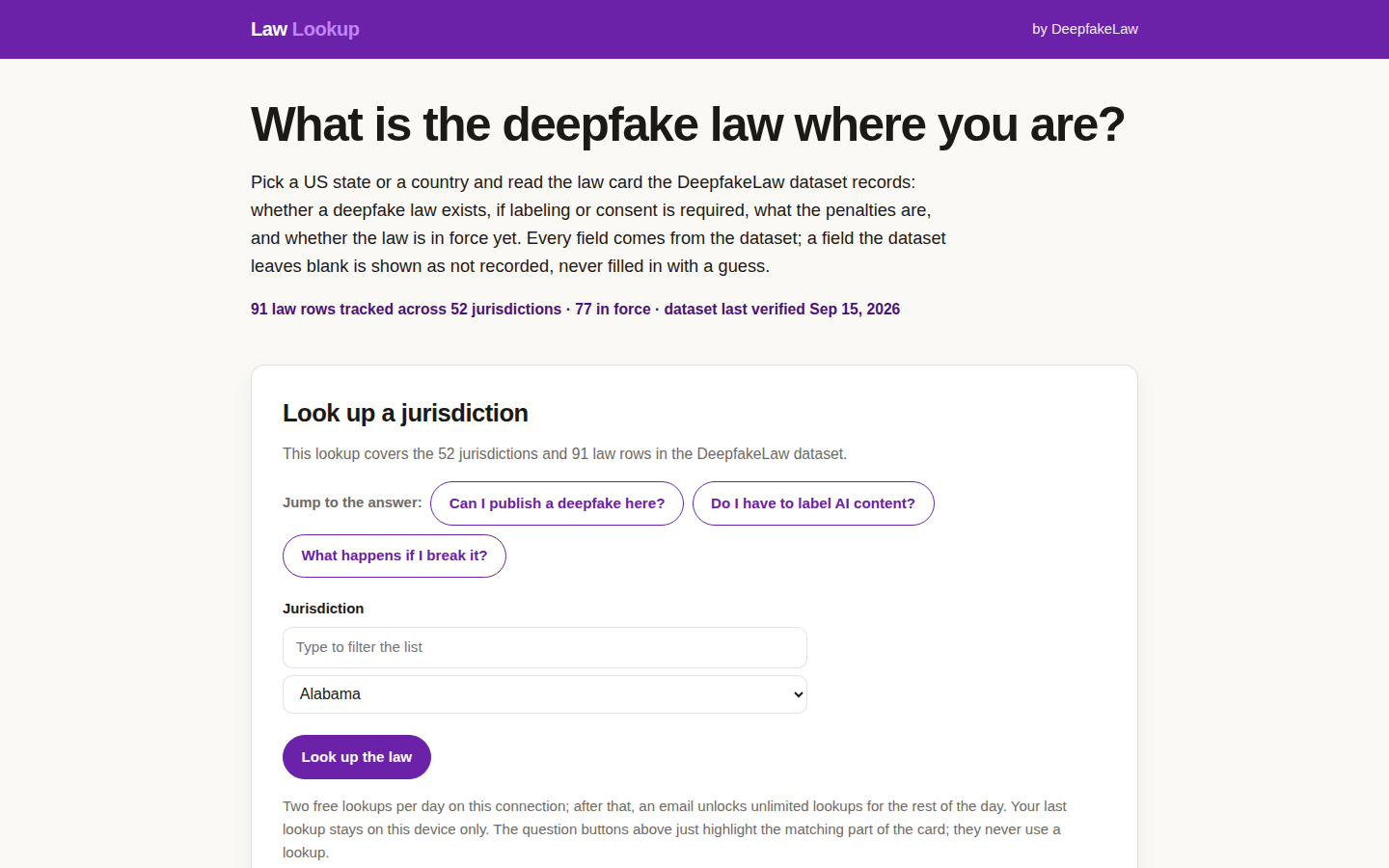
The dataset behind it tracks 91 law rows across 52 jurisdictions, with 77 in force, and it was last verified on September 15, 2026. Every field on a card comes from that dataset. Where the dataset has no verified figure, the card prints "not recorded" instead of a guess, which is exactly the habit you want from a law reference.
How a lookup works
- Pick a jurisdiction. US states, countries, the United States as a whole and the European Union are all on the list.
- Read the card. Status first (in force, enacted but not yet effective, proposed, or repealed), then whether labeling is required, whether consent is required, the penalties, and the effective date.
- Use the three question buttons. "Can I publish a deepfake here?", "Do I have to label AI content?" and "What happens if I break it?" just highlight the matching part of the card; they never spend a lookup.
- Copy or print the card. Keep it with the project it protects.
Two lookups a day are free on your connection; after that, an email unlocks unlimited lookups for the rest of the day, and your last lookup stays on your device only. One honest limit, in the tool's own words: this is a research snapshot for information only, not legal advice, and it must not be relied on for compliance decisions. For the wider map, start with our guide to deepfake laws by state and the explainer on whether a deepfake is illegal at all. If the question is whether a piece of media is real in the first place, the detector on our sister site, DeepfakeDetect, is the other half of the workflow. The companion post walks one full jurisdiction end to end: California, card by card. Or open the Law Lookup and read your own state first.