Minnesota does not have one deepfake law. It has three, and they aim at three different targets: elections, intimate images, and, since 2026, the tools that make the images. All three sit in our tracker as the Minnesota cards, and this post reads them where it counts, in the official texts published by the Minnesota Revisor of Statutes. This is legal information, not legal advice.
Three statutes, three targets
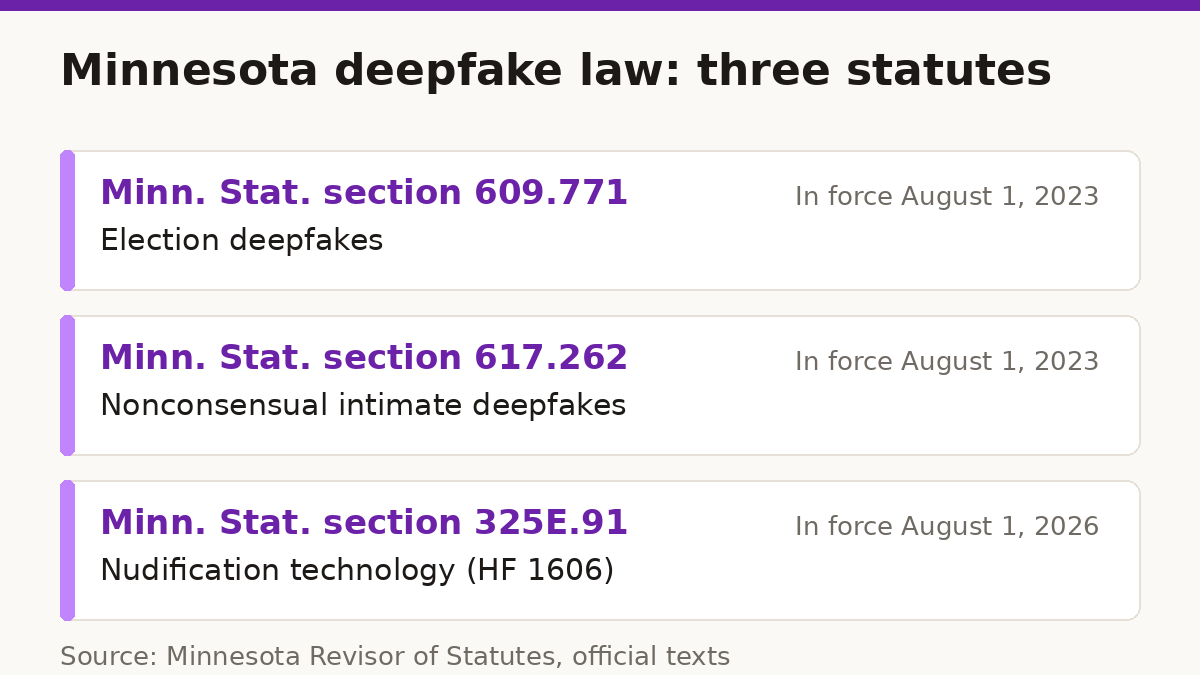
Start with the map. Each law binds a different actor, which is why reading only one of them gives a lopsided picture of what Minnesota actually prohibits.
- Election deepfakes: Minnesota Statutes section 609.771, in force since August 1, 2023. A criminal law aimed at people who disseminate fake media of candidates inside a defined election window.
- Nonconsensual intimate deepfakes: section 617.262, in force since August 1, 2023. A criminal law aimed at people who share fake intimate images of an identifiable person who never consented to the sharing.
- Nudification technology: section 325E.91, created by HF 1606 in 2026 and in force since August 1, 2026. A civil regime aimed at the services that offer the tools, carrying the largest penalties in the state's deepfake set.
The election statute: section 609.771
The election crime has four moving parts. A person disseminates a deep fake, or enters into a contract to disseminate one, knowing it is a deep fake or acting with reckless disregard about whether it is. The dissemination is without the consent of the depicted individual. It is made with the intent to injure a candidate or influence the result of an election. And it takes place inside the statutory window. Miss one element and the section does not reach the conduct.
The window is the part summaries tend to blur, so here is the statute's own test: dissemination must take place either "within 90 days before a political party nominating convention" or "after the start of the absentee voting period prior to a presidential nomination primary, or a regular or special state or local primary or general election." Notice the shape of the second trigger. It names the day the window opens and sets no closing day of its own. For the November 3, 2026 general election, the Minnesota Secretary of State records absentee voting as beginning on September 18, 2026, so disseminations from that date onward in the 2026 cycle fell on the window side of the line the statute draws.
Read the full section and one thing is conspicuously absent: a disclosure defense. Nothing in section 609.771 says that adding a label, a watermark or a disclaimer takes a dissemination outside the crime. Some disclosure laws treat the label as the cure. As written, this statute does not. The only element that concerns the depicted individual is consent, so a clearly labeled fake, published without consent and with intent to injure a candidate inside the window, is still the conduct the section describes.
The base penalty is imprisonment for up to 90 days, a fine of up to $1,000, or both. Committed with the intent to cause violence or bodily harm, the ceiling rises to 364 days or $3,000. A repeat violation within five years of an earlier conviction under the section carries up to five years or $10,000. For a candidate convicted under it, the court must enter a judgment forfeiting the nomination or office, and the conviction disqualifies the person from appointment to that office and to other offices for which the legislature sets qualifications.
Criminal court is not the only door. Section 609.771 also lets the attorney general, a county attorney or city attorney, the depicted individual, and a candidate who is injured or likely to be injured by a dissemination sue for injunctive or equitable relief, which is the route that can stop a fake before election day rather than punish it after. One carve-out: broadcasters and cable systems that carry a candidate-produced deep fake because federal law requires the carriage sit outside the prohibition.
The intimate image statute: section 617.262
Section 617.262 is about the image itself. It is a crime to intentionally disseminate a deep fake when the actor knows, or reasonably should know, that the depicted individual did not consent to the dissemination. The deep fake must realistically depict the intimate parts of another individual presented as the depicted individual's, artificially generated intimate parts presented as theirs, or the depicted individual engaging in a sexual act. And the person must be identifiable, either from the deep fake itself or from personal information displayed alongside it.
The base offense is a gross misdemeanor. It rises to up to three years in prison, a fine of up to $5,000, or both, when any one of seven aggravating factors is present: the depicted individual suffers a financial loss, the actor meant to profit, the actor ran a website or app for the purpose of disseminating the deep fake, the actor posted it on a website, the actor meant to harass, the deep fake was obtained through offenses like theft or computer crime, or the actor has a prior conviction under the chapter.
One clause closes off a familiar argument. It is not a defense that the depicted individual consented to the creation or possession of the deep fake, or privately sent it to someone else. Consent to make is not consent to share. The section carries exemptions for law enforcement, reporting unlawful conduct, medical treatment, scientific research and education, and matters of public interest, and it shields the interactive services and networks that merely carry other people's content.
The 2026 law aims at the tools: section 325E.91
HF 1606 took a different approach. Signed on May 7, 2026 as Chapter 72 of that year's session laws and effective August 1, 2026, it created section 325E.91, a prohibition on nudification technology. Instead of punishing the person who makes an image, it binds whoever owns or controls a website, application, software, program or other service. That person must not allow a user to access, download or use the service to nudify an image or video, and must not nudify one on a user's behalf. Advertising or promoting such a service is prohibited as well. To nudify, in the statute's definition, is to alter or generate an image or video so it depicts an intimate part that was not in the original, realistically enough that a reasonable person would believe the part belongs to an identifiable individual.
The one exemption matters to ordinary software: the prohibition does not apply when the service requires the technical skill of a user, which the law defines as the substantial application of individualized technological or artistic skill and judgment by a human creator in directing, shaping or controlling the output. The money at stake is the largest in Minnesota's deepfake set. A depicted individual may sue the violator for compensatory damages, including mental anguish, up to three times the actual damages sustained, plus punitive damages, injunctive relief and attorney fees. The attorney general, enforcing under section 8.31, can pursue a civil penalty of up to $500,000 for each unlawful access, download or use.
The law has been contested since before it took effect. xAI sued Attorney General Keith Ellison in federal court in July 2026, arguing the ban violates the First Amendment. On September 4, 2026, the district court declined to block the law, resting on the company's delay in suing and on the balance of harms rather than on the constitutional question. On October 2, 2026, the Eighth Circuit granted an injunction pending appeal in a one-sentence order that gave no reasons. The practical effect is narrow: attorney general enforcement against xAI is paused while its appeal proceeds. The statute remains in force, the private lawsuit it hands to depicted individuals was not part of that order, and no court has yet decided whether the law is constitutional.
Minnesota, through the Law Lookup
Our dataset records these three laws as Minnesota's entries among 91 laws across 52 jurisdictions, and the free Law Lookup shows each as a card with its status, effective date and a link to the official text. Two lookups a day are free on your connection; after that, an email unlocks more for the rest of the day. The Minnesota cards also show the tracker's honesty rule at work: the election card states plainly that its penalty specifics were not verified from the current statute text, so every penalty figure in this post comes from the Revisor's text itself, not from the card. New to the tool? The short explainer shows how to read any card in the set.
How this post was written
Every legal statement above was read in the official texts on the Minnesota Revisor of Statutes website in late October 2026: sections 609.771 and 617.262, and Chapter 72 of the 2026 session laws, which enacted section 325E.91. The absentee voting date comes from the Minnesota Secretary of State, and the litigation status from the federal court record in xAI's case. Laws get amended and appeals get decided, so check the official text before relying on any of it, and treat this post as information, not legal advice. For the wider picture, our election law explainer compares deepfake and disclaimer rules across states, and our deepfake porn law penalties post lines Minnesota's intimate image penalties up against the rest of the country.